1-Step vs 2-Step Prop Firm Challenge: Which One Fits Your Trading Style?
Program Guide
1-Step vs 2-Step Prop Firm Challenge: Which One Fits Your Trading Style?
The difference between a 1-step and 2-step prop firm challenge is not just speed. It affects the pressure you trade under, the way drawdown rules shape your decisions, and which type of trader is more likely to perform consistently over time.
RebelsFunding Editorial Team • Prop Trading Education • Program Comparison
Quick answer
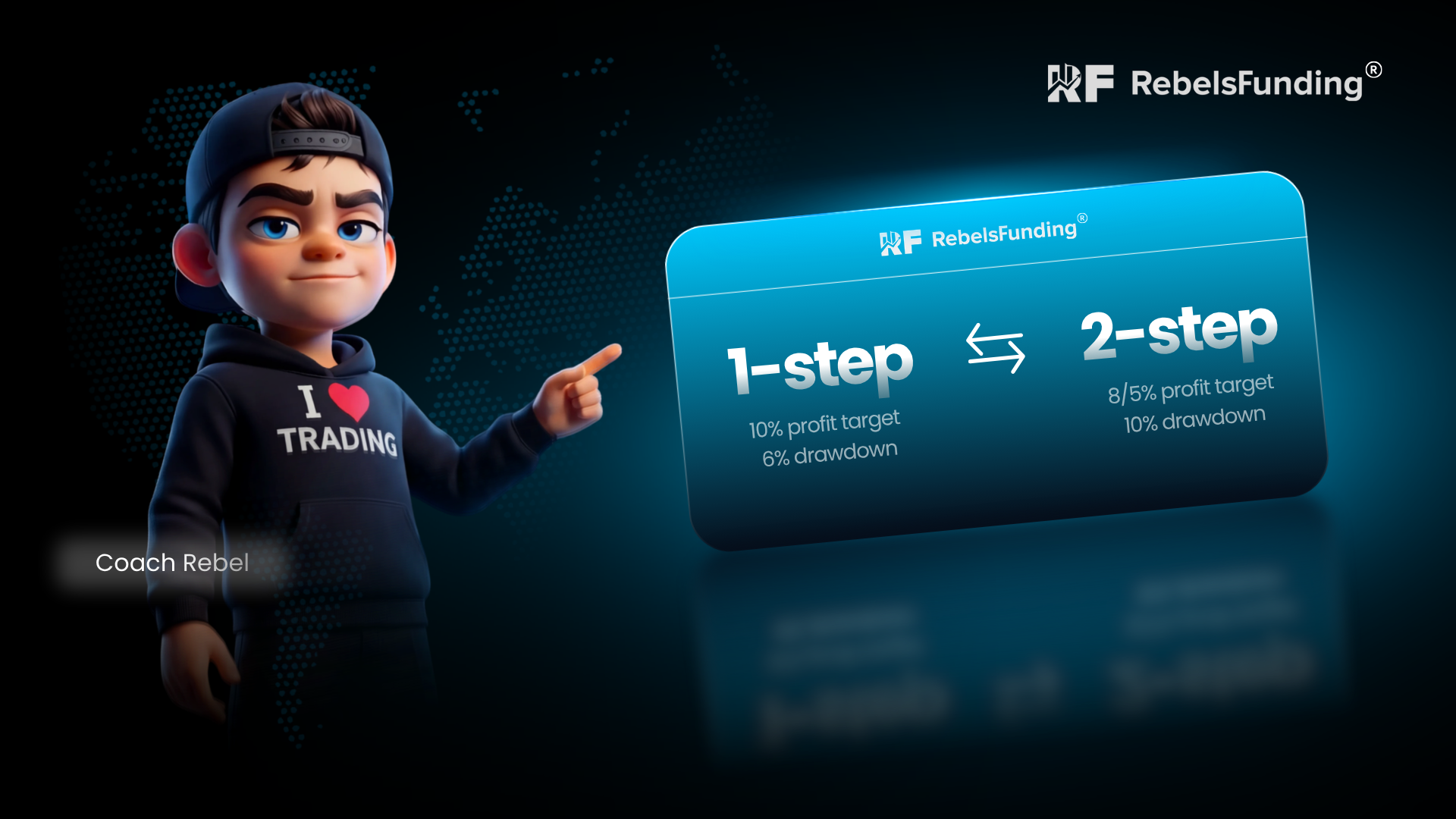
A 1-step prop firm challenge is usually better for traders who already have a proven process and want a shorter path to evaluation. A 2-step prop firm challenge is often better for traders who prefer more structure, a split target, and more room to prove consistency across multiple phases. On RebelsFunding Programs, the practical comparison is between Gold 1-Phase and Silver 2-Phase.
What does a 1-step vs 2-step prop firm challenge actually mean?
The main difference is how the evaluation is structured. In a 1-step model, you complete one verification phase before moving forward. In a 2-step model, you must pass two separate evaluation phases. That changes how you manage risk, how quickly you can finish, and how much psychological pressure builds inside the process.
At RebelsFunding, this distinction is clear. Gold 1-Phase is built for traders who want a direct route through a single evaluation phase. Silver 2-Phase adds another layer of verification and suits traders who prefer a more staged process. You can also review the broader rule framework on the full rules page and the FAQ.
Important: a 1-step challenge is not automatically “easier,” and a 2-step challenge is not automatically “safer.” The better fit depends on your consistency, drawdown control, patience, and whether your edge performs better under a shorter or more gradual evaluation structure.
1-step vs 2-step prop firm challenge: practical comparison
Evaluation structure
1-step
One verification phase. Cleaner path, fewer stages, faster decision point.
2-step
Two separate evaluation phases. More structure and more time spent proving repeatability.
Drawdown logic
Gold 1-Phase
No daily drawdown during the evaluation phase, but a tighter 6% overall drawdown means you still need disciplined risk control.
Silver 2-Phase
5% daily drawdown and 10% overall drawdown. More total room on the account, but with a daily reset rule that changes intraday decision-making.
Profit target and pace
1-step
One 10% target.
2-step
Split targets of 8% and 5%.
Trade count, leverage, and capital range
Gold 1-Phase
Minimum 8 real trades, leverage up to 1:50, account sizes from $2,500 to $40,000.
Silver 2-Phase
Minimum 6 real trades in each phase, leverage up to 1:100, account sizes from $2,500 to $80,000.
When a 1-step prop firm challenge makes more sense
A 1-step model is usually a stronger fit when your execution is already stable and you do not need two phases to prove discipline to yourself. It is particularly attractive for traders who want fewer moving parts and dislike stretching the evaluation over multiple checkpoints.
- You already trade from a written process and do not need a long ramp-up period.
- You prefer a shorter route with one clear target.
- You are comfortable operating without a daily drawdown rule in the evaluation phase, while still respecting the tighter overall limit.
- You want a simpler comparison between your strategy and the challenge rules.
If that sounds like you, the most relevant starting point is Gold 1-Phase. If you want to strengthen process quality before scaling, it also makes sense to review Trader Consistency Score and Preparation of a Trading Plan.
When a 2-step prop firm challenge is the better fit
A 2-step model often suits traders who want to demonstrate consistency across a longer sequence rather than through one concentrated phase. It can also feel more comfortable for traders who prefer staged progress and a more traditional evaluation flow.
- You prefer performance being verified over two phases rather than one.
- You want a split target instead of a single all-in-one milestone.
- Your strategy handles daily risk limits well and you are used to managing intraday exposure tightly.
- You value a more staged progression before moving on.
In that case, Silver 2-Phase is the most relevant page to review. If you want more context on why structured evaluation matters, see Why Rigorous Prop Firm Evaluations Lead to Long-Term Trader Success.
Decision filter
Choose the model that matches your real trading behavior, not the one that sounds faster
If your results depend on stable position sizing, disciplined stop losses, and low emotional variance, a 1-step path may suit you well. If your performance becomes stronger when it is tested across multiple checkpoints, a 2-step path may be more natural. Review all available options on the Programs page, try the Free Trial, or use the Competition if you want an additional performance benchmark.
Next step
Compare RebelsFunding programs in one place
If you already know you want a direct comparison of structure, rules, and fit, start with the full programs overview. If you would rather test your process first, use the Free Trial. If you want to pressure-test yourself in a different format, review the Competition.
Compare RebelsFunding ProgramsCommon mistakes traders make when comparing 1-step and 2-step challenges
A common mistake is comparing only the number of phases and ignoring the full rule environment. Traders often overlook how daily drawdown, total drawdown, leverage, and minimum trade requirements can change the real difficulty of a challenge.
Another mistake is choosing the model that feels emotionally attractive rather than the one that matches your actual data. Before deciding, review your own consistency, position sizing habits, and drawdown behavior. Helpful related reads include Trading Mistakes to Avoid for Success and What to Do When You Feel Like Quitting Trading.
FAQ
Is a 1-step prop firm challenge easier than a 2-step challenge?
Not by default. A 1-step challenge has fewer phases, but it may also require stronger execution in a tighter structure. The better question is which model fits your trading behavior more naturally.
What is the main advantage of a 1-step prop firm challenge?
Its main advantage is simplicity. You have one evaluation phase, a cleaner process, and a more direct route for traders who already have a stable strategy.
What is the main advantage of a 2-step prop firm challenge?
Its main advantage is staged verification. For many traders, two phases create a more structured environment for proving consistency over time.
Can I test my approach before choosing a funded program?
Yes. The Free Trial is the most practical starting point if you want to test your process first and compare your execution with the demands of a funded workflow.
Where can I compare all RebelsFunding challenge options?
Use the Programs page for the full overview, and the rules page if you want a deeper look at the detailed conditions behind each model.

Join Our Traders
 Small Prop Firm Account Strategy: How to Trade a Low-Cost Challenge Seriously
PROP TRADING RISK GUIDE A small prop firm challenge can reduce the…
 Why Beginners Should Master One Trading Setup First
BEGINNER TRADING GUIDE Beginners often try to learn several strategies at once.…
 Can Prop Firms Refuse a Payout? What Traders Should Check First
PAYOUT RULES GUIDE A payout request is not only about profit. It…