Static Stop Loss vs Trailing Stop Loss in Prop Trading: What Traders Must Know
PROP TRADING RISK GUIDE
Stop-loss settings can strongly affect how traders manage risk in a prop firm challenge. A static stop loss gives the trade a fixed risk point, while a trailing stop loss can move with price once the trade starts working in the trader’s favor.
RebelsFunding Blog · Prop Trading Education · Trade Risk Management
Quick answer
Static stop loss vs trailing stop loss is a key difference in trade risk management. A static stop loss stays fixed at one price level, while a trailing stop loss can move behind price as a profitable trade develops. For prop traders, the better choice depends on the strategy, volatility, position size and account risk plan.
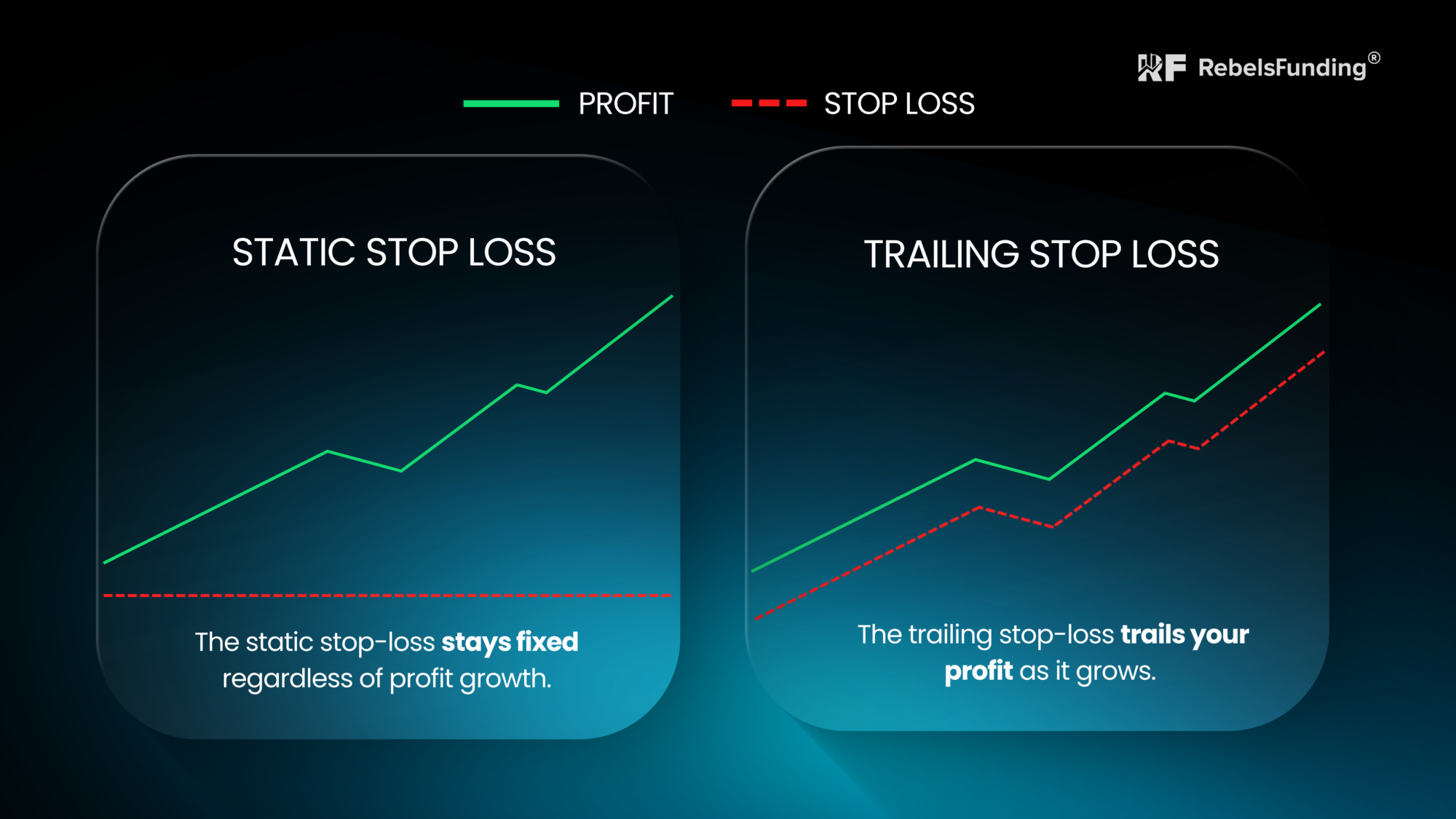
Static stops keep risk fixed. Trailing stops can move with a profitable trade.
Many traders compare prop firm challenges by price, account size, profit target or payout split. Those factors matter, but they do not replace trade protection. In a challenge environment, one poorly managed position can quickly reduce the account buffer.
That is why the exit plan matters before the trade is opened. A stop loss is not just a platform setting. It is the point where the trader accepts that the trade idea may no longer be valid.
Core idea
A static stop loss defines risk from the start. A trailing stop loss can follow a profitable trade and help protect part of the open profit.
What is a static stop loss?
A static stop loss is a fixed exit level placed at a specific price. Once it is set, it stays there unless the trader changes it manually. If the market reaches that level, the position closes according to the order conditions.
This method is simple and clear. The trader knows the planned risk before entering. A static stop is useful when the setup has a clear invalidation level, such as a support zone, resistance zone, swing high or swing low.
Takeaway: a static stop loss is best when the trader wants a clear and predefined risk point before entry.
What is a trailing stop loss?
A trailing stop loss is an exit order that can move as the market moves in the trader’s favor. Instead of staying at the original level, it can follow price by a selected distance.
The main advantage is flexibility. A trailing stop can help traders stay in a winning trade while protecting part of the move. The main risk is sensitivity. If the trailing distance is too tight, normal market noise can close the trade too early.
Platform guide
How to enable a trailing stop on RF-Trader
RebelsFunding explains how to enable a trailing stop directly on RF-Trader. The relevant part starts around minute 3:36.

Static stop loss vs trailing stop loss: main difference
The simplest difference is this: a static stop stays fixed, while a trailing stop can move after the trade becomes profitable.
Stop loss is not the same as drawdown
Some traders confuse trade exits with drawdown rules. They are connected to risk, but they are not the same thing. A stop loss belongs to a specific position. Drawdown belongs to the account or challenge limits.
The same applies to trailing stop and trailing drawdown. A trailing stop is a trade management tool. Trailing drawdown is an account-level rule used by some firms.
Which one is better for prop traders?
There is no universal answer. A static stop loss may be better when the trader wants a clear risk level and a precise invalidation point. A trailing stop loss may be better when the trader wants to protect profit while giving a strong position more room to continue.
In prop trading, the answer must also respect account limits. Even a strong setup can become dangerous if the stop is too wide, the position size is too large or the trader keeps changing the exit emotionally. Traders should understand the official RebelsFunding rules, basic drawdown limit management and common stop-loss mistakes.
Use static stop loss when
You have a clear invalidation level and want fixed risk before opening the trade.
Use trailing stop loss when
The trade is moving in your favor and your strategy allows the exit to follow price.
Avoid emotional changes
Changing stop-loss settings because of fear, hope or revenge trading can break the original risk plan.
Why this matters in a prop firm challenge
In a personal account, poor stop-loss management can damage capital. In a prop firm challenge, it can also damage the trader’s chance of passing the evaluation or keeping the account within the allowed limits.
At RebelsFunding, traders can use the platform environment to build better habits around risk, trade management and discipline. Before choosing a paid challenge, traders can review the available programs, read the official rules or start with the Free Trial.
Manage risk before profit
Choose a program and trade with a clear risk plan
Before entering a challenge, understand the rules, account limits and trade management tools. Your exit method should support your strategy, not replace discipline.
Compare ProgramsYou can also start with the Free Trial if you want to explore the platform first.
Final thoughts
Static stop loss vs trailing stop loss is not only a technical comparison. It is a practical risk-management decision. One method gives traders a fixed exit level. The other can follow a profitable trade and help protect part of the move.
Neither method is automatically better. A static stop can be clearer and easier to control. A trailing stop can be useful when the trader wants to stay in a winning move. The important point is that the method must fit the strategy, market conditions and prop trading account limits.
FAQ: Static stop loss vs trailing stop loss
What is the difference between static stop loss and trailing stop loss?
A static stop loss stays at a fixed price level unless the trader changes it manually. A trailing stop loss can move as the trade moves in the trader’s favor.
Is a trailing stop the same as trailing drawdown?
No. A trailing stop is connected to an individual trade. Trailing drawdown is an account-level rule connected to the maximum allowed account loss.
Which stop loss is better for prop trading?
Neither is always better. Static stops are useful for fixed invalidation levels. Trailing stops are useful for trades that move into profit and need flexible protection.
Can stop-loss settings help in a prop firm challenge?
Yes. Stop-loss settings help traders control risk on individual trades. In a prop firm challenge, disciplined use of protective exits can help protect the account and reduce unnecessary rule violations.

Join Our Traders
 Can Prop Firms Refuse a Payout? What Traders Should Check First
PAYOUT RULES GUIDE A payout request is not only about profit. It…
 How to Trade Double Top and Double Bottom Patterns
TRADING STRATEGY GUIDE How to Trade Double Top and Double Bottom Patterns…
 From Zimbabwe to 16 Payouts: How Bazell Built Consistency with RebelsFunding
FUNDED TRADER INTERVIEW From Zimbabwe to 16 Payouts: How Bazell Built Consistency…