Lot size determines how large your forex position is. But choosing 0.01, 0.10 or 1.00 lot should not be a guess. A disciplined trader calculates position size from the amount they are prepared to risk, the stop-loss distance and the pip value of the currency pair.
RebelsFunding Blog – Forex Education – Risk Management
Quick answer: What is lot size in forex?
Forex lot size determines how much of the base currency a trader controls in a position, while pip value determines how much money is gained or lost when the exchange rate moves by one pip. A standard lot usually represents 100,000 currency units, a mini lot 10,000 and a micro lot 1,000. The correct forex lot size should be calculated from acceptable monetary risk and stop-loss distance, not from account balance alone.
If you open 1.00 lot on EUR/USD, a one-pip move has a much larger monetary effect than the same move on a 0.01 lot position.
That sounds simple, but lot size is one of the areas where new traders frequently confuse position size, risk, pip value, leverage and margin.
A large position does not automatically mean a bad trade, and a small lot does not automatically mean a safe one. Risk depends on both the size of the position and the distance between entry and the point where the trade is closed.
The useful approach is therefore to work backwards from risk. Decide how much of the account you are prepared to lose if the setup fails, identify a logical stop-loss level and calculate the position size from those two variables.
Core principle
Choose the risk first. Define the stop-loss second. Calculate the lot size third.
Standard, Mini, Micro and Nano Lots Explained
Forex positions are commonly expressed in lots. One lot represents a standardized quantity of the base currency, which is the first currency displayed in a currency pair.
Standard lot
1.00 lot
100,000 units
Mini lot
0.10 lot
10,000 units
Micro lot
0.01 lot
1,000 units
Nano lot
0.001 lot
100 units
Not every platform supports every position size. RebelsFunding currently lists a minimum forex volume of 0.01 lot for major forex instruments such as EUR/USD, GBP/USD and USD/JPY.
Contract sizes, leverage and minimum volumes can differ between instruments. Traders should therefore check the current RebelsFunding Trading Instruments specifications rather than assuming every market works like EUR/USD.
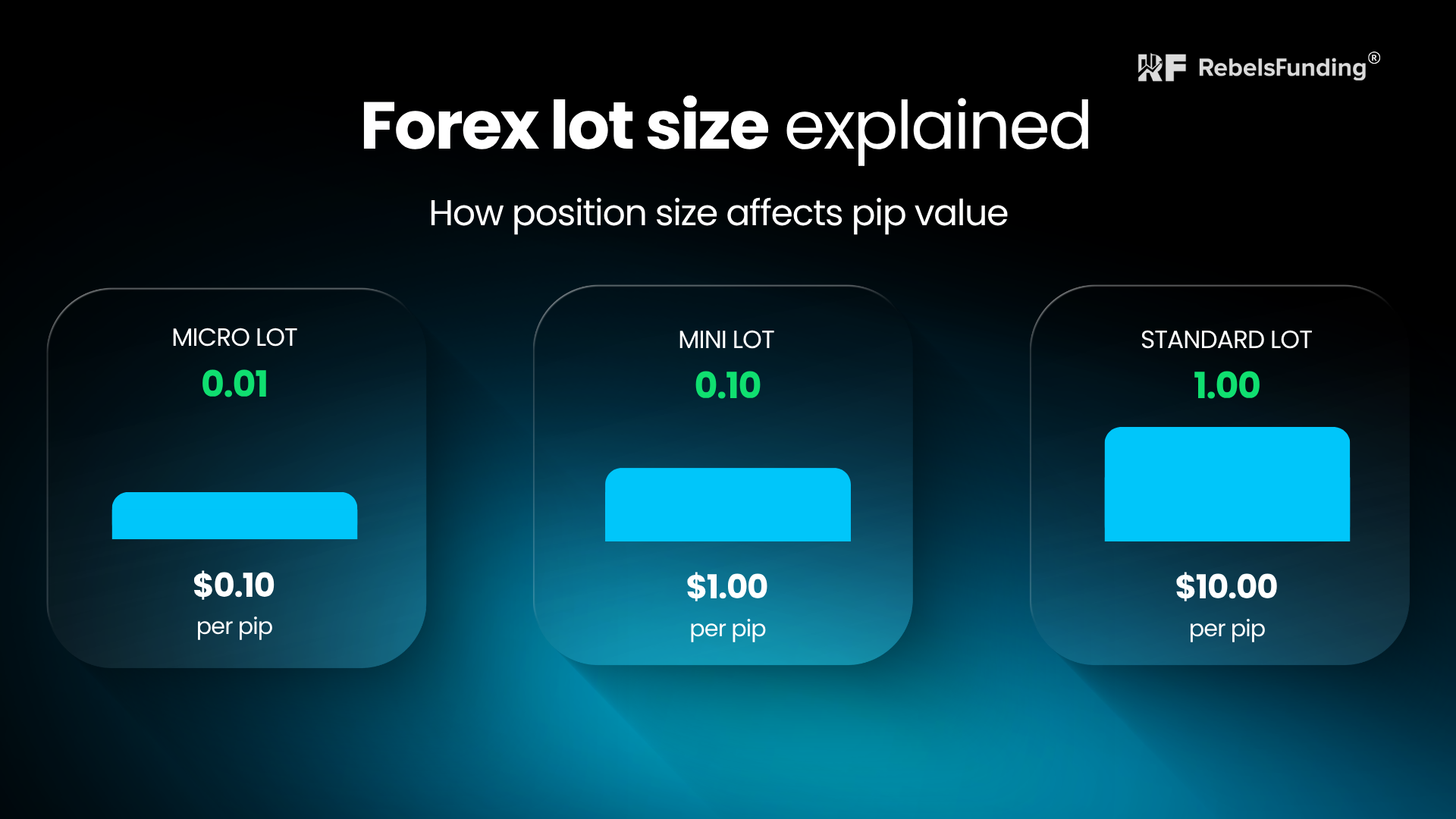
What Does 0.01, 0.10 and 1.00 Lot Mean in Forex?
These are some of the most common forex lot size searches, so it is useful to make the difference concrete.
Using EUR/USD as an example:
Illustrative EUR/USD pip values for a USD-denominated account.
0.01 lot
Base currency: €1,000
Approx. pip value: $0.10
0.10 lot
Base currency: €10,000
Approx. pip value: $1
1.00 lot
Base currency: €100,000
Approx. pip value: $10
Saying that “0.01 lot equals $1,000” is therefore incomplete. A micro lot represents 1,000 units of the base currency.
For EUR/USD, 0.01 lot means €1,000 of nominal currency exposure. Its equivalent value in dollars changes with the EUR/USD exchange rate.
The nominal position size should also not be confused with the amount the trader is risking. A €10,000 nominal EUR/USD position does not mean the trader is risking €10,000. Planned risk depends mainly on pip value and stop-loss distance.
How Much Is One Pip Worth in Forex?
A pip is a standard unit used to describe changes in the exchange rate of a forex pair.
For most major currency pairs, one pip equals 0.0001. For pairs involving the Japanese yen, a pip is normally 0.01.
For a USD-denominated account trading a pair where USD is the quote currency, such as EUR/USD or GBP/USD, the approximate pip values are straightforward:
0.01 lot
$0.10 per pip
20 pips = $2
0.10 lot
$1 per pip
20 pips = $20
0.50 lot
$5 per pip
20 pips = $100
1.00 lot
$10 per pip
20 pips = $200
These are illustrative values before spread, commission and slippage.
Basic pip value formula
Formula
Pip value in quote currency = Position size in units × Pip size
For one standard lot of EUR/USD:
100,000 × 0.0001 = $10 per pip
Because USD is the quote currency, the result is already expressed in dollars.
Why pip value can be different on USD/JPY
JPY pairs use 0.01 as one pip. For one standard lot of USD/JPY:
100,000 × 0.01 = ¥1,000 per pip.
If USD/JPY were trading at an illustrative 150.00, converting the pip value into dollars gives approximately:
¥1,000 ÷ 150 = $6.67 per pip.
This is why “one standard lot equals $10 per pip” is only a shortcut for certain currency pairs and account currencies. Pip value may need to be converted.
How to Calculate Forex Lot Size Step by Step
A useful forex position-size calculation starts with the amount you are willing to lose if the trade is wrong.
Step 1: Calculate your monetary risk
Suppose you have a $5,000 simulated account and decide to risk 0.5% on one trade.
$5,000 × 0.5% = $25 planned risk.
Step 2: Measure your stop-loss distance
Assume the EUR/USD setup becomes invalid 25 pips away from the planned entry. The technical stop is therefore 25 pips.
Step 3: Calculate the correct lot size
Position size formula
Lot size = Risk amount ÷ (Stop loss in pips × Pip value per 1.00 lot)
For EUR/USD in a USD-denominated account:
$25 ÷ (25 × $10) = 0.10 lot
At 0.10 lot, EUR/USD is worth approximately $1 per pip.
25 pips × $1 per pip = $25 planned loss.
The position size now matches the intended 0.5% risk before spread, commission and potential slippage.
Forex Lot Size Examples for Different Account Sizes
To see how the calculation scales, assume the same conditions for every account:
This does not mean 0.10 lot is always correct for a $5,000 account or 2.00 lots is always correct for $100,000.
Those figures apply only because every example uses the same 0.5% risk and 25-pip stop. Change either variable and the correct lot size also changes.
How Stop-Loss Distance Changes Your Lot Size
This is one of the most important concepts in forex position sizing.
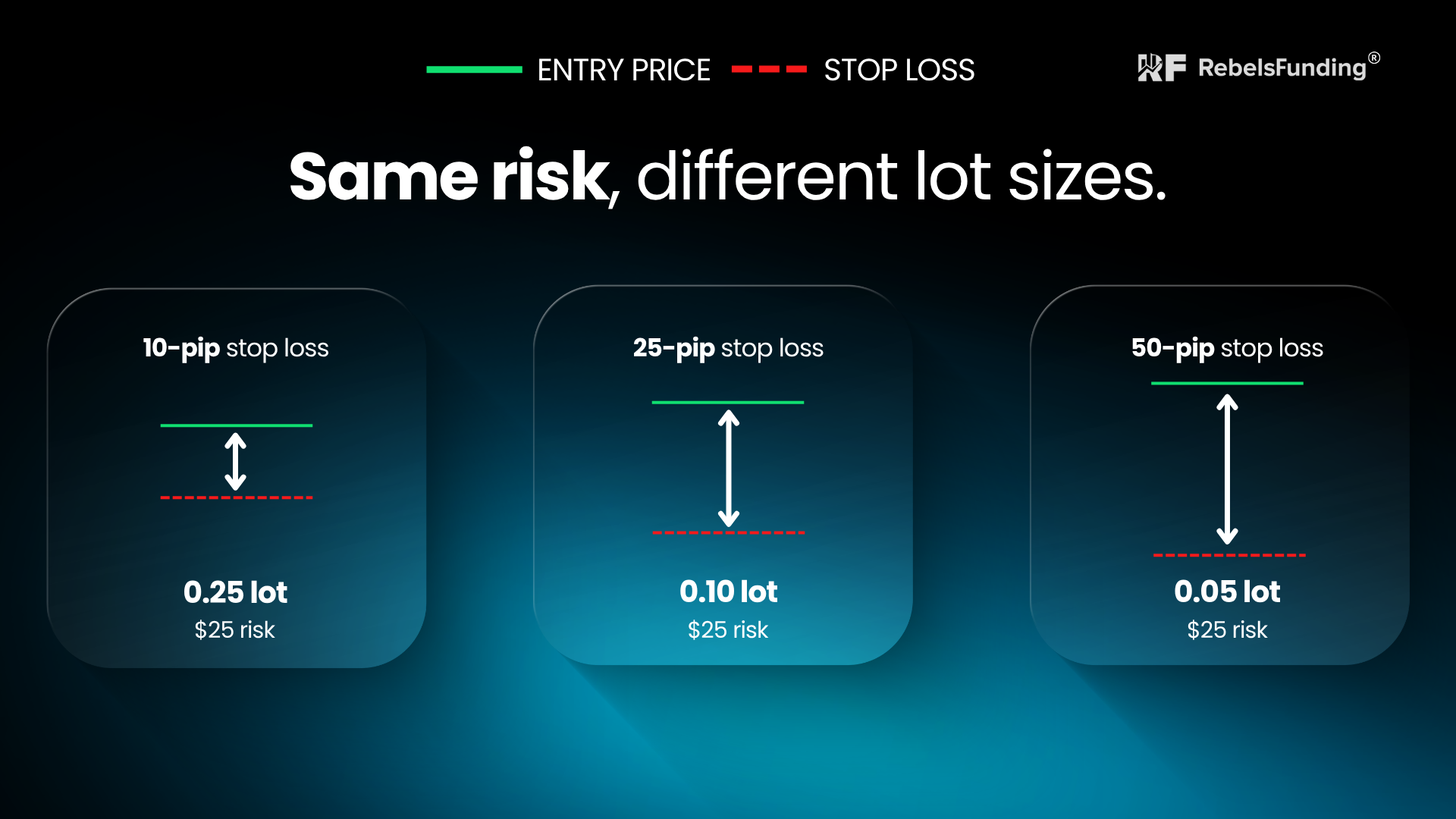
Suppose the account is still $5,000 and the trader still wants to risk exactly $25. Only the technical stop-loss distance changes.
Same $25 planned risk on EUR/USD: a wider stop requires a smaller lot size.
10-pip stop
Risk: $25
0.25 lot
25-pip stop
Risk: $25
0.10 lot
50-pip stop
Risk: $25
0.05 lot
The wider the stop loss, the smaller the position must become if monetary risk is supposed to remain constant.
This relationship also explains why traders should not select a large lot size first and then squeeze the stop loss closer simply to make the risk calculation fit.
Better sequence: Identify where the setup is technically invalid first. Measure the distance from entry to that level. Then calculate the lot size that keeps the monetary loss within your predefined limit.
Lot Size vs Leverage vs Margin: What Is the Difference?
Lot size, leverage and margin are connected, but they describe different parts of a forex position.
Lot size
Defines how large the position is and therefore how much a one-pip movement is worth.
Leverage
Determines how much market exposure can be controlled relative to the margin requirement.
Margin
Is the account equity required or reserved to support an open leveraged position.
Increasing available leverage does not make a 0.10 lot EUR/USD position worth more per pip. In a USD-denominated account, its pip value remains approximately $1 per pip.
Higher leverage mainly changes the amount of margin required to control that position and makes greater market exposure possible. It should not be confused with the amount a trader intends to risk.
How to Calculate Lot Size for a Prop Firm Challenge
The same position-sizing principles become particularly important in prop trading because account drawdown rules place defined boundaries around losses.
Account size → acceptable loss → stop-loss distance → lot size
Consider a $10,000 simulated challenge account where the trader wants to risk 0.5% on one EUR/USD setup.
Account: $10,000
Risk: 0.5% = $50
Stop loss: 20 pips
EUR/USD pip value at 1.00 lot: approximately $10
$50 ÷ (20 × $10) = 0.25 lot
If exactly the same account and risk level were used with a 50-pip technical stop:
$50 ÷ (50 × $10) = 0.10 lot.
The account did not change. The risk percentage did not change. The appropriate lot size changed because the stop-loss distance changed.
This is why rules such as “use 0.5 lot on a $10K account” are incomplete. Account balance alone does not contain enough information to calculate a position.
The same principle applies when starting with a smaller Evaluation. Our Small Prop Firm Account Strategy explains why percentage-based risk habits are more useful than focusing only on nominal dollar amounts.
A theoretical calculation is also not a guarantee of the exact final loss. Spread, commission and slippage can affect execution.
For this reason, traders should avoid sizing a position so aggressively that an ordinary execution difference puts an account close to its maximum risk limits.
Common Forex Lot Size Mistakes
1. Choosing lot size from account balance alone A $10,000 account does not have one universally correct lot size. Risk and stop-loss distance are also required.
2. Using exactly the same lot size on every setup A 10-pip stop and a 50-pip stop produce very different monetary risk at the same lot size.
3. Assuming one standard lot is always $10 per pip The shortcut works for common USD-quoted pairs in a USD-denominated account, but it is not universal.
4. Confusing leverage with risk High available leverage allows a trader to control greater exposure. It does not mean the trader should use that capacity.
5. Moving the stop closer just to increase lot size The technical setup should determine invalidation. Position size should then adapt to that distance.
6. Ignoring execution costs Spread, commission and slippage mean the final result may differ from a perfect calculator result.
Forex Lot Size Checklist
Before opening a forex position, check these five variables:
1. Account size: Which balance or equity figure are you using to calculate risk?
2. Risk amount: How much are you prepared to lose if the setup fails?
3. Stop-loss distance: How many pips separate entry from technical invalidation?
4. Pip value: How much is one pip worth for this pair, lot size and account currency?
5. Lot size: What trading volume keeps the potential loss within your risk limit?
Know the contract before the trade
Check lot sizes, leverage and minimum volume for each instrument
Forex pairs, metals, indices, energies and other instruments do not all use the same contract specifications. Check the current instrument details before calculating your position.
Forex lot size is not simply a number selected from a trading platform.
It is the link between the technical trade setup and the amount of account equity placed at risk.
Start with your acceptable monetary loss. Identify where the trade idea becomes invalid. Measure the stop-loss distance. Calculate the pip value. Only then select the appropriate lot size.
For EUR/USD in a USD-denominated account, the calculation is relatively simple because one standard lot is approximately $10 per pip. Other currency pairs and account denominations may require an additional currency conversion.
If you remember only one principle from this guide, make it this: the correct forex lot size comes from risk and stop-loss distance — not from account size alone.
Frequently Asked Questions
What is 1 lot in forex?
One standard forex lot generally represents 100,000 units of the base currency. For example, 1.00 lot of EUR/USD represents €100,000 of nominal position size.
What is 0.01 lot in forex?
0.01 lot is a micro lot and usually represents 1,000 units of the base currency. On EUR/USD in a USD-denominated account, the pip value is approximately $0.10 per pip.
How much is 0.10 lot per pip?
On USD-quoted pairs such as EUR/USD or GBP/USD, 0.10 lot is approximately $1 per pip in a USD-denominated account. Pip values can differ when the quote currency and account currency are different.
How do I calculate lot size in forex?
First calculate the amount you want to risk, then measure your stop loss in pips and determine pip value. For common USD-quoted pairs, lot size can be calculated as: risk amount ÷ (stop-loss pips × pip value per standard lot).
What lot size should I use on a $5,000 account?
There is no single correct lot size for a $5,000 account. At 0.5% risk with a 25-pip EUR/USD stop, for example, the calculated position is 0.10 lot. A different stop distance or risk percentage produces a different position size.
Does leverage change pip value?
No. Leverage changes the amount of margin required to control a position. Pip value depends on the currency pair, position size and conversion into the account currency.
Why does a wider stop require a smaller lot size?
If monetary risk remains constant, a wider stop exposes the trade to more pips of movement. The lot size therefore has to decrease so that the total planned loss stays within the same risk limit.
How should prop traders calculate lot size?
Prop traders can use the same position-sizing calculation but should also consider account drawdown limits, spread, commission, slippage and exposure from other open trades. Maximum available leverage should not be treated as a target position size.
This article is for educational purposes only and does not constitute financial or investment advice. Lot sizes, contract specifications, leverage, spreads, commissions and minimum trade volumes can differ between instruments and may change. The calculations above are illustrative and generally exclude spread, commission and slippage unless stated otherwise. RebelsFunding Evaluation and RCF Accounts are simulated accounts and are subject to the applicable Program Rules, Terms & Conditions and instrument specifications. Always check the current platform information before placing a trade.



 Small Prop Firm Account Strategy: How to Trade a Low-Cost Challenge Seriously
 Order Blocks in Forex: How to Identify and Trade Them
 Forex Market Open Gaps: Why Monday Can Be Risky