What Is Trader Consistency Score? How It Works and What Affects It
Platform Guide
What Is Trader Consistency Score? How It Works and What Affects It
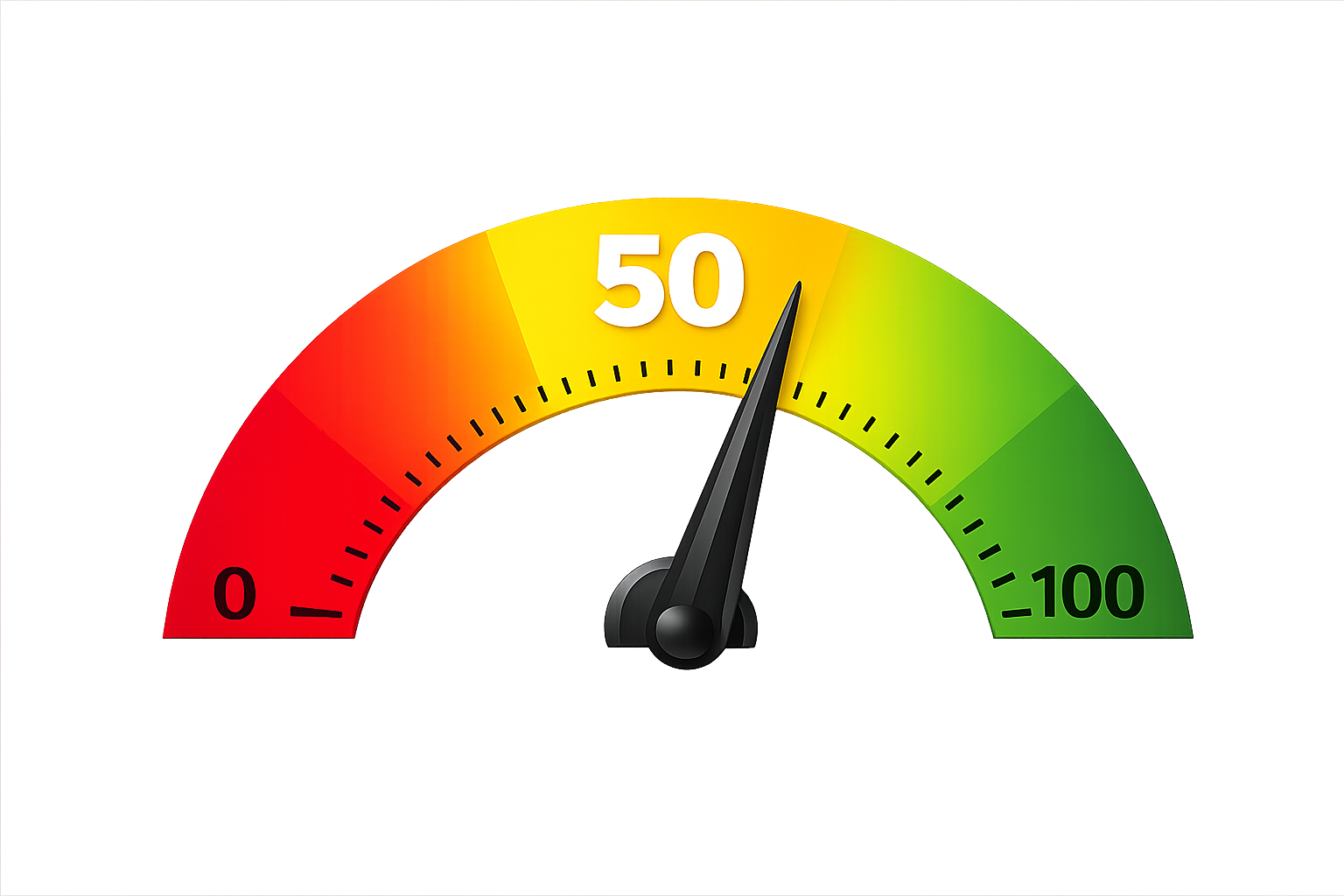
Trader Consistency Score is a 0–100 rating that helps traders understand whether their results come from stable, disciplined execution or from oversized risk, volatility, and one-off hits.
RebelsFunding Editorial Team · Platform Guide · Trading Education
Quick answer
Trader Consistency Score is an internal analytical score from 0 to 100 that evaluates how stable, disciplined, and risk-aware a trader’s behavior is. It does not look only at profit or loss. It also looks at position sizing, drawdown, stop loss usage, recovery quality, profit concentration, and whether the overall trading profile appears consistent rather than aggressive or gambling-like.
- Higher score = more stable and disciplined trading behavior.
- Lower score = more volatility, uneven risk, or signs of chaotic execution.
- A trader can be in profit and still have a low score.
- A low score does not automatically mean a rule breach.
The idea behind Trader Consistency Score is simple: a final result does not always show the full quality of a trader’s process. Two traders can reach a similar profit, but one may get there through smooth execution and controlled risk, while the other may rely on oversized positions, one large hit, or erratic volume changes.
That is why the score focuses on how results are achieved, not only on the final number. If you are still building your routine, it makes sense to start with the Free Trial, review the available Programs, and use the RebelsFunding blog to strengthen your trading process before you scale further.
Why profit alone is not enough
A profitable account does not automatically mean stable trading. If most of the result came from one large trade, a sudden volume spike, or a highly aggressive recovery after losses, the final outcome may look better than the underlying process actually is.
Trader Consistency Score is designed to measure whether performance is built on repeatable behavior. In practice, that means looking at the quality of risk management, the smoothness of progress, and whether the trading pattern suggests discipline or instability.
Important context
Trader Consistency Score is an internal analytical indicator. It helps explain trading quality and behavioral stability. It is not financial advice, and it is not a single absolute verdict on a trader.
How to read the Trader Consistency Score
Score range
80–100
Very good consistency
Trading is stable, disciplined, and supported by solid risk management.
Score range
60–79
Good consistency
The profile is healthy overall, but there is still room to improve stability.
Score range
40–59
Average
Some elements are working, but weak points are reducing overall consistency.
Score range
20–39
Weak
Trading is inconsistent, risk is often unbalanced, or large extremes are present.
Score range
0–19
Very weak
The profile appears highly risky, chaotic, or closer to gambling behavior than disciplined trading.
Inside the platform, the score can be paired with AI-generated commentary that highlights both strengths and weaknesses. For example, traders may see positive signals such as high win rate, stable position sizing, or strong recovery factor, alongside weaker areas such as low stop loss usage, inconsistent loss management, or excessive risk concentration.

What goes into the score
Trader Consistency Score looks at a combination of trading metrics rather than a single datapoint. That gives a more realistic view of behavior over time.
Metric
Win Rate
What it measures
Percentage of trades that closed in profit.
Why it matters
Useful, but not enough on its own without the size of wins and losses.
Metric
Profit Factor
What it measures
Total profits compared with total losses.
Why it matters
Shows whether gains meaningfully outweigh losses over time.
Metric
Risk/Reward Ratio
What it measures
The balance between potential reward and risk per trade.
Why it matters
A healthier ratio suggests better trade planning.
Metric
Position Sizing Consistency
What it measures
How stable trade size remains over time.
Why it matters
Large and sudden jumps in volume reduce confidence in discipline.
Metric
Max Consecutive Losses
What it measures
The longest losing streak.
Why it matters
Long losing streaks may reveal strategy or discipline problems.
Metric
Max Drawdown
What it measures
The largest peak-to-trough decline on the account.
Why it matters
Deeper drawdowns usually mean more aggressive or poorly controlled risk.
Metric
Recovery Factor
What it measures
How well the account recovered after drawdown.
Why it matters
Healthy recovery is a sign of resilience without overreaction.
Metric
Stop Loss Usage Ratio
What it measures
How often stop loss is used across trades.
Why it matters
Regular stop loss use generally supports better discipline.
Metric
Progress Smoothness
What it measures
Whether account growth was gradual or dependent on a few jumps.
Why it matters
Smoother progress suggests more repeatable trading behavior.
Metric
Rolling Stability
What it measures
Whether performance stayed stable during the full period.
Why it matters
Consistency across time matters more than a strong finish alone.
The anti-gambling logic behind the score
One of the most important parts of Trader Consistency Score is that it does not evaluate performance in isolation. It also checks whether the result looks natural and sustainable or whether it resembles gambling behavior.
What can lower the score
- One trade or a few trades generate most of the final profit.
- The target is reached very quickly on a very small sample of trades.
- One trading idea is split into too many partial closes to inflate activity.
- A single trade has an outsized impact on the account.
- Trade volume suddenly spikes far above the usual pattern.
- Position size increases sharply after a loss, which may resemble martingale behavior.
- Stop loss usage is weak, inconsistent, or chaotic.
- Certain unusual hedging or repetitive patterns appear unnatural or excessively risky.
Simple rule
The score tends to rise when trading is stable, position sizing is controlled, stop loss is used consistently, and account growth is smoother. It tends to fall when results depend on aggressive risk, sudden volume changes, deep drawdowns, or one-off outsized trades.
How to improve your Trader Consistency Score
Improving the score is usually less about chasing more profit and more about building cleaner execution. In most cases, that means reducing avoidable extremes and creating a more repeatable process.
- Keep position sizing more consistent from trade to trade.
- Use stop loss more regularly and more logically.
- Avoid trying to recover losses with sudden size increases.
- Reduce dependence on one large winner to carry the whole result.
- Focus on smoother account growth instead of faster but unstable growth.
- Treat discipline as part of performance, not as a separate topic.

For many traders, the most practical first step is to reduce variability. That can mean setting a more fixed risk per trade, avoiding emotional size changes, and using stop loss in a more systematic way. If you want to build those habits in a lower-pressure environment, the Free Trial is a useful place to start before moving into a funded workflow.
Next step
Build consistency before you scale risk
If you want a more structured path, review the full Programs page and compare options such as Gold 1-Phase. If you want a more competitive benchmark, you can also look at the Competition.
What a low score does and does not mean
A low score does not automatically mean that a trader broke a rule. It is better understood as a quality signal. It shows that the current trading pattern may be more aggressive, less stable, or less disciplined than a stronger consistency profile.
That is an important distinction. The purpose of the score is not only to rank results, but also to help traders understand where their process may need refinement. In that sense, it works best as a feedback tool rather than as a simple pass-or-fail label.
FAQ
What does Trader Consistency Score mean?
Trader Consistency Score is an internal rating from 0 to 100 that evaluates trading stability, discipline, risk management, and whether the result appears consistent rather than overly aggressive.
Why is my score low even if I am in profit?
Because the score does not measure profit alone. If the result was created through large volume jumps, deep drawdown, weak stop loss usage, or one dominant trade, the score may still be lower.
Why did my consistency score drop?
A score can drop after larger drawdown, a losing streak, weaker stop loss discipline, aggressive position size changes, or when a large part of the result comes from one trade.
Does stop loss usage help the score?
Yes. Regular and reasonable stop loss usage is a positive factor because it supports risk control and more stable execution.
Does a low score mean I violated the rules?
Not automatically. A low score is better understood as a signal that the trading style may be more aggressive or less disciplined, not as automatic proof of a breach.
Is the score 100% exact?
No analytical model is perfect. Trader Consistency Score is a useful internal evaluation built on multiple trading metrics, but it should still be understood as a model-based assessment rather than a single absolute verdict.

Join Our Traders
 Small Prop Firm Account Strategy: How to Trade a Low-Cost Challenge Seriously
PROP TRADING RISK GUIDE A small prop firm challenge can reduce the…
 Why Beginners Should Master One Trading Setup First
BEGINNER TRADING GUIDE Beginners often try to learn several strategies at once.…
 Can Prop Firms Refuse a Payout? What Traders Should Check First
PAYOUT RULES GUIDE A payout request is not only about profit. It…